
AI for customer engagement has moved beyond basic chatbots and automated ticket deflection. Today, AI can support agents during live calls, analyze customer interactions, automate routine tasks, and give contact center leaders better visibility into performance and customer journeys.
For small and mid-sized contact centers, these capabilities can help lean teams manage higher customer expectations, tighter compliance demands, and growing interaction volumes. AI can reason through information, take defined actions, and surface relevant insights without adding more manual work for agents or supervisors.
For operations managers, IT leaders, and supervisors, the goal is not simply to add AI to the contact center. It is to use AI alongside actionable reporting and oversight to improve efficiency, identify risks, and make faster, more informed decisions about agent and customer performance.
What Is AI-Driven Customer Engagement?
AI-driven customer engagement uses artificial intelligence to understand customer intent, retain conversation context, and take action across voice and digital channels. Instead of following a fixed script, modern AI agents, copilots, and analytics can use information from each interaction to help customers and agents resolve issues more efficiently.
For example, a customer could ask a virtual agent about a billing charge, reschedule an appointment, or troubleshoot a simple product issue. The AI can access relevant customer information, provide an answer, complete the requested action, or transfer the interaction to the right agent when human support is needed. For SMB contact centers, the goal is not to build a futuristic AI lab. It is to improve service while reducing the manual effort required from a lean team.
AI should also work with the systems a contact center already uses. Xima’s AI contact center software can connect AI capabilities with existing telephony and customer workflows, helping teams add intelligent assistance without replacing their entire technology stack.
How AI Transforms Customer Engagement
AI can affect the metrics contact center managers monitor every day, including first contact resolution, average handle time, abandonment rates, and quality scores. By automating repetitive work and giving agents better information, AI helps teams manage more interactions without relying solely on additional staff.
The operational benefit comes from reducing the time and effort required at each stage of an interaction. Faster routing, fewer repeat calls, automated documentation, and broader quality monitoring can help lower operating costs while maintaining consistent customer service.
Boosting First Contact Resolution Across Voice and Digital
Customers are more likely to resolve an issue on the first attempt when the right information reaches the right agent. AI can combine customer interaction history with intelligent routing to identify the appropriate skill or department before a call reaches an agent, reducing unnecessary transfers and repeat contacts.
For example, a customer calling about a billing issue can be routed directly to an agent with the appropriate billing skills instead of moving between departments. Xima’s skills-based routing helps contact centers direct interactions based on agent skills and availability.
Lowering Average Handle Times Without Rushing Callers
Agents can spend valuable call time searching through knowledge bases, customer records, and internal documents. AI-powered assistance can surface relevant information during the conversation, while automated summaries and wrap-up tasks reduce the work required after the customer hangs up.
This can lower overall handle time without encouraging agents to rush customers through conversations. Instead, agents spend less time on administrative tasks and more time addressing the customer’s actual issue.
Cutting Abandonment Rates During Peak Call Spikes
Unexpected call spikes can quickly create long queues and frustrated customers. Instead of requiring callers to remain on hold until an agent becomes available, AI-enabled contact centers can offer queue callbacks that preserve the caller’s place in line.
This gives customers an alternative to waiting on hold while helping supervisors manage sudden increases in demand. Agents can continue working through the queue, while the callback system automatically reconnects customers when capacity becomes available.
Transitioning from Sample-Based to Complete Quality Assurance
Traditional quality assurance often depends on managers reviewing a small sample of calls. Reviewing just 2% of interactions can leave significant blind spots, making it difficult to identify whether a problem is isolated to one agent or affecting the broader contact center.
AI-powered quality management can evaluate every interaction against defined criteria and flag issues such as compliance errors, missed steps, or negative customer sentiment. Xima’s quality management capabilities give supervisors broader visibility so they can identify systemic training gaps instead of relying on a handful of manually reviewed calls.
Practical Applications of AI for Customer Engagement
The value of AI becomes clearer when viewed from each side of the interaction. Customers receive faster answers and more flexible service options, agents get relevant information while they work, and supervisors gain data they can use to monitor performance and identify trends.
Answering Repetitive Questions with Self-Service
A customer might text a contact center to check an order status or reschedule an appointment. An AI messaging tool can verify the customer’s information, look up the relevant account details, send the requested confirmation, and complete the interaction without taking an agent away from a live call.
This type of self-service is especially useful for high-volume, predictable requests. Agents remain available for customers who need more complex assistance while routine interactions are handled automatically.
Eliminating Long Hold Times with Callbacks
Imagine a customer calling during a midday rush and hearing that the estimated wait is 20 minutes. Rather than staying on hold and listening to music, the caller can choose a callback and keep their place in the queue.
When an agent becomes available, the system automatically calls the customer back and connects them to the next available representative. The contact center can continue working through the queue while customers avoid spending time waiting on an active call.
Pulling Answers onto the Agent’s Screen During Live Calls
An agent handling a difficult warranty claim may need to confirm eligibility, review coverage rules, or determine the next step. Instead of searching through multiple documents while the customer waits, AI can identify the question and surface the relevant policy or knowledge article on the agent’s screen.
The agent can use that information to guide the conversation and follow the appropriate process. This reduces manual searching while giving less experienced agents more support during complicated interactions.
Uncovering Customer Trends and Churn Risks with Speech Analytics
Speech analytics can turn thousands of daily conversations into data that supervisors can analyze. Automated speech recognition transcribes calls and can identify recurring complaints, competitor mentions, common topics, and changes in customer sentiment.
For example, a sudden increase in calls mentioning a specific product problem could signal an issue that needs attention before it generates more contacts. Xima’s speech analytics tools help supervisors turn conversation data into trends they can monitor and act on.
Automated Scoring on Every Inbound Call
Manual QA might require a supervisor to listen to only a few calls from each agent each month. Automated scoring can evaluate every inbound interaction against defined quality and compliance criteria, creating a much broader view of agent performance.
The system can flag compliance errors, identify conversations with negative sentiment, and alert supervisors when an interaction requires attention. Instead of searching through recordings to find problems, managers can focus their time on the calls and agents that need coaching.
Best Practices for Implementing AI Customer Engagement Tools
AI implementation does not have to mean changing every contact center workflow at once. Starting with a few high-volume use cases allows supervisors to measure results, adjust configurations, and give agents time to adapt.
- Start with common requests. Set up self-service for two or three predictable call reasons, such as business hours, account balances, or order lookups.
- Connect customer information. Make relevant phone, chat, and SMS history available to agents so they can understand the customer’s situation before repeating questions.
- Create a clear escalation rule. If a bot cannot resolve an issue after two attempts, route the customer to an agent and pass along the conversation history.
- Monitor performance closely. Use supervisor dashboards during the first month to identify long calls, dropped interactions, routing problems, and other issues that require adjustment.
- Align AI with staffing. Combine interaction data with workforce management tools to understand how automation affects staffing needs and customer demand.
How Xima Software Powers AI-Driven Customer Engagement
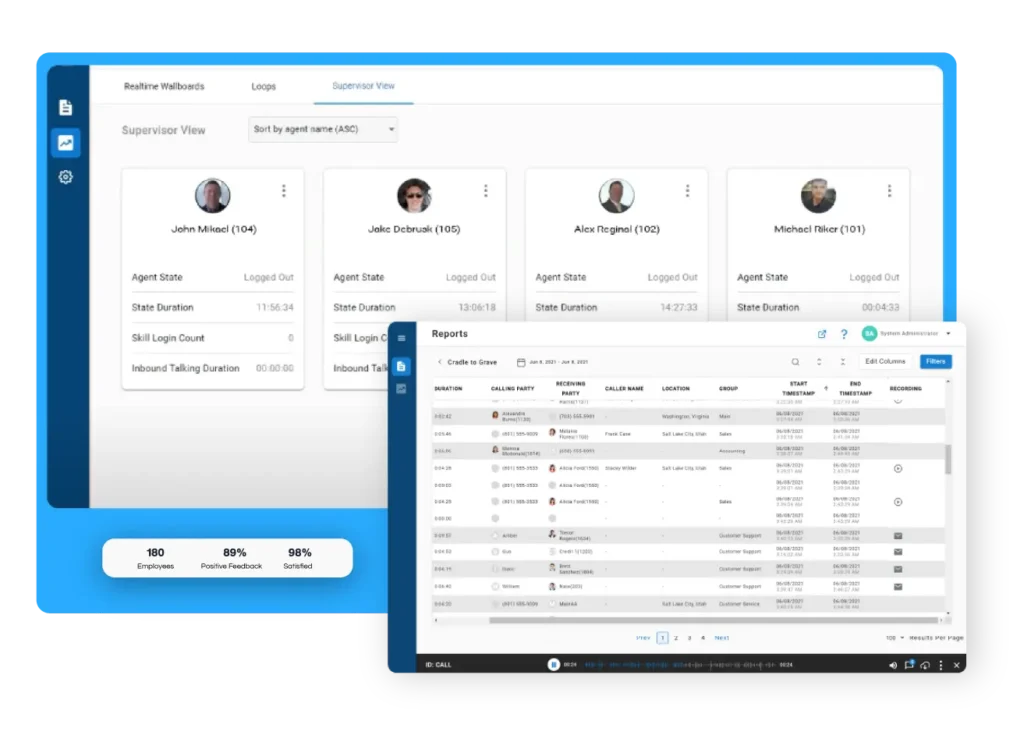
AI works best when contact center leaders can see what is happening across every interaction. Xima Software combines cradle-to-grave interaction reporting, speech analytics, intelligent queue callbacks, and real-time agent dashboards to help supervisors monitor performance and identify areas for improvement.
Xima captures call activity from start to finish, giving managers visibility into interaction outcomes, customer sentiment, topics, and agent performance. AI messaging bots can handle repetitive requests, while queue callbacks give customers an alternative to waiting on hold and help reduce abandoned calls.
These tools address practical contact center challenges without requiring teams to lose visibility into their operations. Supervisors can use real-time dashboards and historical reporting to understand where customers are encountering friction, where agents need support, and how changes affect performance.
Ready to see how AI and better reporting can support your contact center? Schedule a custom demo with Xima Software to explore cloud contact center tools, live reporting, and AI-powered agent assistance.
FAQs About AI for Customer Engagement
The right AI tool depends on the contact center’s needs. Omnichannel contact center platforms combine AI with routing, reporting, analytics, and agent support, while conversational chatbots focus on automated customer interactions. CRM systems use AI to organize customer data, automate workflows, and support personalized engagement.
AI is generally used to support agents rather than replace them. It can handle routine requests, surface information, and automate administrative work while human agents focus on complex or high-empathy interactions.
Implementation time varies based on the tool, integrations, and complexity of existing systems. Starting with a focused use case, such as self-service or automated reporting, can allow teams to introduce AI without changing the entire contact center at once.
Common challenges include integrating AI with existing systems, maintaining accurate customer data, training agents to use new tools, and establishing appropriate oversight. Clear use cases, gradual implementation, and ongoing performance monitoring can help teams address these issues.