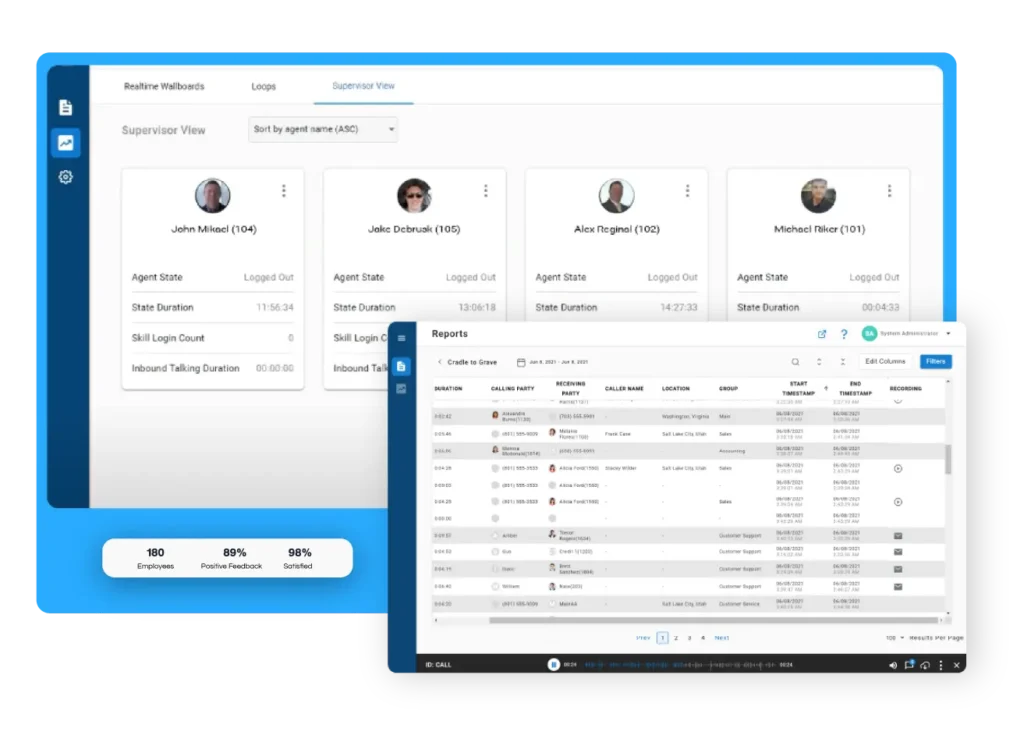

Operational efficiency in a contact center comes down to a simple question: how much useful work can your team get done without wasting time, money, or effort?
For operations managers, IT leaders, and supervisors, that usually means resolving more customer issues without adding unnecessary headcount, reducing handle time, improving first-contact resolution, and keeping quality and compliance consistent. The challenge is that many contact centers still rely on disconnected systems, manual reviews, and reports that tell managers what happened after the fact.
AI is changing that. Instead of acting as a standalone add-on, AI can become part of how interactions are routed, handled, analyzed, and monitored throughout the day.
This guide looks at what that shift means for contact centers, where AI can improve daily operations, the use cases worth considering now, and what a practical implementation can look like.
Benefits of Using AI for Operational Efficiency
AI can improve operational efficiency in several ways, but the value comes from solving specific problems. For a contact center, that might mean reducing the amount of time supervisors spend reviewing calls, helping customers get answers faster, or giving agents useful information without making them search for it themselves.
Reduced staffing costs
Peak demand does not always justify hiring more full-time employees. AI can help contact centers handle periods of higher call and message volume by taking care of routine requests and reducing the amount of repetitive work reaching live agents.
That can give smaller teams more flexibility during seasonal spikes or unexpected increases in demand. Better planning can also help managers use existing staff more effectively. Xima covers several practical ways to reduce call center costs without simply cutting service capacity.
Fewer data entry mistakes
Manual data entry creates friction for both agents and customers. A name, account number, order detail, or date entered incorrectly can lead to another interaction, another correction, and more time spent fixing a problem that should have been resolved the first time.
AI and automation can reduce some of that work by extracting information from customer messages, forms, and other inputs and moving it into the systems employees already use. The less information agents have to retype, the fewer opportunities there are for simple mistakes.
Faster customer response times
Customers generally do not care which automation technology sits behind a response. They care about getting an answer without waiting.
AI-powered customer service tools can respond to common questions immediately, whether the customer is asking about an account, an order, a policy, or another routine issue. That reduces pressure on the live queue and leaves agents with more time for conversations that require judgment or empathy.
This is one reason AI call center agents are becoming part of the broader contact center technology stack.
Shorter call durations
Long calls are not always a sign of poor performance. Some issues genuinely take time to solve. The problem is when an agent spends that time searching for customer information, reviewing previous interactions, or asking the caller to repeat details the business already has.
AI can summarize interaction history and surface relevant information so the agent starts with context instead of a blank screen. That can shorten unnecessary portions of a call while giving the customer a more informed experience.
Immediate quality assurance
Traditional QA depends on supervisors finding the right calls and listening to them manually. That makes it difficult to identify problems quickly, especially when a team handles a large volume of interactions.
AI can evaluate conversations against predefined criteria and flag issues such as missed compliance language, script deviations, or other quality concerns. Instead of waiting for a random call review, managers can focus on the interactions that actually need attention.
Faster document retrieval
Agents do not always need another person. Sometimes they just need the right piece of information.
A searchable AI system can help employees find a policy, procedure, product detail, or internal document without digging through folders or asking a manager where something lives. For a contact center, that can be especially useful when agents work across multiple products, policies, or customer scenarios.
Preventative maintenance
AI-driven efficiency also extends beyond customer-facing workflows. In operations environments, software can analyze equipment and sensor data to identify patterns that suggest maintenance will soon be needed.
That gives teams an opportunity to address a problem before a failure causes downtime. IBM highlights predictive maintenance as one example of AI being used to identify potential equipment issues early and schedule maintenance proactively.
Practical Use Cases for AI in Daily Operations
The most useful AI applications are usually the ones that solve a problem managers already recognize. In a contact center, that means using AI to improve staffing decisions, reduce manual QA work, and remove unnecessary administrative tasks.
Forecasting Call Volumes
Contact centers already have a valuable source of planning data: their own interaction history.
AI can examine historical call patterns alongside current queue conditions to help managers understand when demand is likely to rise and where additional coverage may be needed. Instead of relying entirely on yesterday’s schedule or a manager’s best guess, supervisors can use current and historical data to make staffing decisions.
This becomes particularly useful when call patterns change by time of day, day of week, season, campaign, or customer activity.
Speeding Up Quality Assurance
Manual QA is difficult to scale. A supervisor can listen to only so many calls in a day, and the sample they review may not represent what is happening across the contact center.
AI changes the volume equation by evaluating interactions automatically. Xima’s AI capabilities are designed around 100% interaction coverage, allowing teams to evaluate calls against defined criteria and identify interactions that warrant closer attention.
For supervisors, that means less time searching through recordings and more time working directly with agents. A recurring compliance issue, coaching opportunity, or performance trend can be identified across the broader interaction set instead of being discovered by chance.
Removing After-Call Typing
After-call work is easy to overlook because it happens outside the customer conversation, but it adds up quickly across a busy team.
AI can generate interaction summaries and reduce the amount of manual documentation required after a call. Instead of typing a detailed recap before moving on, an agent can review the generated information and make any necessary adjustments.
That keeps more of the agent’s time focused on customers while still giving managers and systems the information they need. Xima’s broader AI contact center capabilities bring these types of workflow improvements together inside the contact center environment.
Catching Compliance Errors Instantly
Compliance issues are often easier to fix when they are caught early.
Speech analytics can analyze conversations for specific phrases, patterns, and behaviors that may indicate a missed requirement or other compliance concern. With the right configuration, supervisors can identify interactions that deserve immediate attention rather than discovering the issue weeks later during a manual review.
Xima’s contact center speech analytics can turn conversations into searchable, structured data that helps managers identify trends, monitor quality, and verify adherence.
Steps to Implement AI for Operational Efficiency
AI implementation does not need to begin with a complete technology overhaul. A focused rollout gives teams a chance to solve one problem well, measure the result, and build from there.
- Identify the slowest internal process. Start with a workflow that regularly consumes time. This could be manual call review, after-call documentation, repetitive customer questions, or another process that creates a noticeable bottleneck.
- Choose software that connects directly to the existing customer database. AI becomes much more useful when it can work with the information your team already relies on. Look for technology that fits into the existing contact center and business systems rather than creating another isolated data source.
- Train the staff on how to read the newly generated data reports. New AI tools still require people to understand what the output means and how to act on it. Supervisors should know which metrics matter, how to interpret alerts, and when human review is still necessary.
Start small, measure the change, and expand once the workflow is working reliably. That approach also gives employees time to get comfortable with AI before it becomes part of more critical processes.
Future of AI in Business Operations
The next phase of AI is likely to move beyond analysis and assistance toward more direct execution.
Autonomous Workflows
AI systems are increasingly being designed to move from identifying a need to taking action across connected systems.
A future workflow might begin with a customer explaining a billing issue. Instead of simply identifying the problem, an AI agent could access the billing system, apply the appropriate business rules, issue a refund, update the account, and send the customer a confirmation.
The important distinction is that the system is not just generating an answer. It is completing a series of related tasks within defined permissions and business rules.
Modular Software
Businesses also have more options for adding AI without replacing every system they already own.
Instead of buying an entirely new platform, organizations can increasingly add specialized capabilities to their existing technology stack. One team might use a demand forecasting tool while another adds automated document processing or an AI assistant for internal support.
That modular approach can make AI adoption more manageable because companies can target specific problems instead of taking on a massive technology project all at once.
Automate Contact Center Tasks with Xima Software
For small and mid-sized contact centers, operational efficiency often comes down to getting more value from the systems and people already in place.
Xima brings AI into that day-to-day workflow through capabilities designed to automate routine work, improve quality visibility, and help supervisors act on performance data faster.
Xima’s AI Voice Bot can answer incoming calls and handle routine customer requests before they reach a live agent. The AI Messaging Bot extends similar self-service capabilities to messaging channels, helping customers get answers without waiting in a phone queue.
Behind those customer-facing tools, Auto QA automatically evaluates interactions against defined criteria. That gives managers a much broader view of agent performance than manual call sampling alone and makes it easier to identify coaching and compliance opportunities.
Xima Insights adds another layer by helping supervisors understand not just which metrics changed, but why. Instead of spending time digging through multiple reports to find the source of a problem, managers can use AI-driven analysis to surface performance trends and root causes.
The result is a contact center where automation handles routine work, AI analyzes interactions, and supervisors have clearer information for the decisions that still require human judgment.
Schedule a demo with Xima to see how AI can fit into your existing contact center operation.
FAQs About AI Operational Efficiency
As a contact center grows, small inefficiencies become larger operational costs. AI can help teams handle more interactions, reduce repetitive work, and improve visibility without requiring every increase in demand to be matched by additional manual effort.
Start with the metrics connected to the problem you are trying to solve. Depending on the workflow, that could include average handle time, first-contact resolution, labor hours, call volume handled through self-service, QA coverage, or other operating costs.
AI can take some repetitive work out of an agent’s day, such as answering routine questions, finding information, or documenting an interaction. That gives agents more time for complex conversations that require human judgment, empathy, and problem-solving.
RPA typically automates repetitive, rule-based tasks such as moving information between systems or filling out forms. AI can go further by interpreting language, analyzing unstructured information, recognizing patterns, and supporting decisions. The two technologies can also work together.
AI can be useful at many contact center sizes. For small and mid-sized teams, the value can be especially practical because supervisors and agents often wear multiple hats and have less capacity for manual QA, repetitive documentation, and other time-consuming processes.