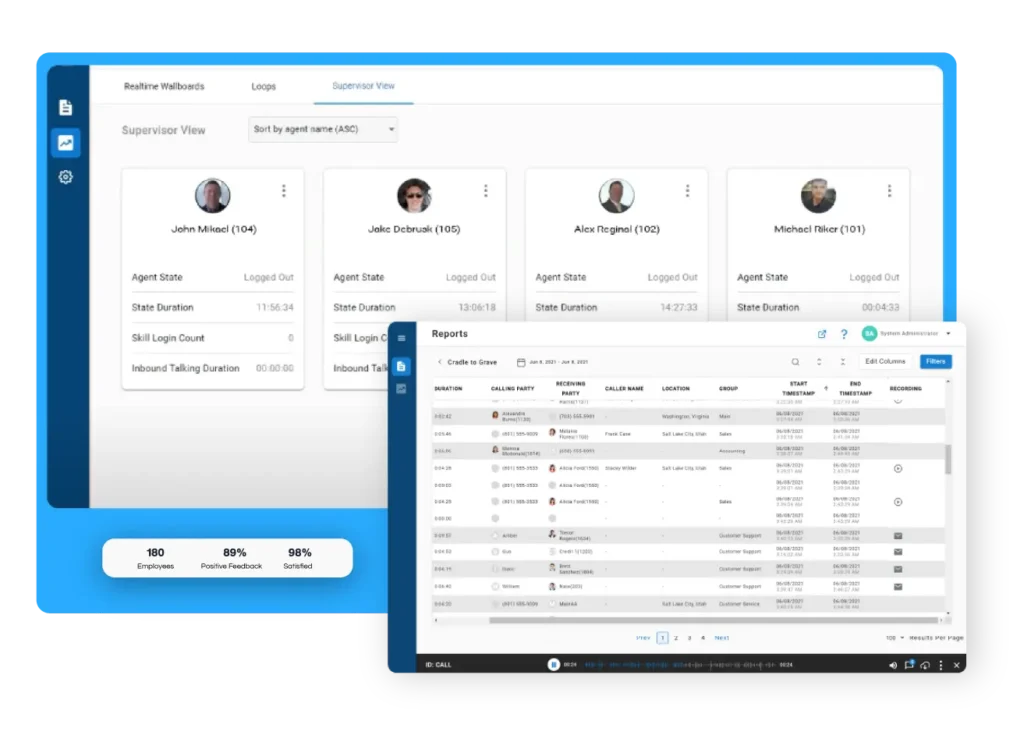

AI call center agents offer a more scalable approach. These tools can take over repetitive tier-one requests while supporting human agents during live conversations, helping contact centers reduce routine workloads, improve response times, and give agents more capacity for complex customer needs.
What Is an AI Call Center Agent?
An AI call center agent is software that uses technologies such as natural language processing (NLP) and machine learning to understand and respond to routine customer requests across voice, SMS, and web chat. Unlike traditional automated systems that rely primarily on predetermined menus, AI-powered contact center solutions can interpret customer intent and use available information to guide the interaction.
AI agents generally fall into two categories. Autonomous virtual agents handle self-service tasks such as checking balances, resetting credentials, or answering common account questions without human involvement. Agent-assist tools work alongside human representatives, analyzing conversations in real time to surface suggested responses, relevant customer context, and knowledge resources while automating tasks such as call notes. Together, these applications allow AI to handle routine work while keeping human agents involved where judgment, empathy, or more complex problem-solving is needed.
Types of AI Call Center Agents
AI call center agents generally fall into three categories based on who they support:
- Customer-Facing Virtual Agents: Conversational voice bots and website chatbots interact directly with customers, answering common questions and completing basic tasks without requiring a live representative.
- Agent-Assist Tools: These tools work alongside live reps to retrieve account information, suggest relevant responses, surface helpful resources, and automatically summarize conversations.
- Supervisor and Operational AI: Behind-the-scenes AI helps supervisors automate quality assurance, monitor customer sentiment, identify performance trends, and route interactions to the appropriate teams.
Practical Use Cases for AI Call Center Agents
AI agents can handle simple customer requests independently or support more complex workflows that still require human involvement.
Transactional Self-Service: AI agents can resolve high-volume, straightforward requests directly within phone or messaging channels. Customers can reset account credentials, verify their identity, check shipping or inventory status, process basic returns or cancellations, schedule appointments, and get answers to common policy questions without waiting for a representative.
Complex Workflows and Representative Assistance: AI can also guide multi-step interactions or support agents during live conversations. This can include walking customers through equipment troubleshooting, securely processing payments or setting up standard payment plans, analyzing sentiment to surface relevant knowledge base content, and triggering proactive SMS or email updates for shipping delays and appointment reminders.
How AI Agents Transform Call Center Operations
By automating routine interactions and supporting agents and supervisors with real-time information, AI can improve several of the metrics that shape daily contact center performance. The impact can be seen in resolution times, handle times, quality assurance coverage, and call routing.
Faster First Contact Resolution on Routine Queries
Conversational AI can immediately handle common tier-one requests such as tracking orders, scheduling appointments, and completing basic troubleshooting. Resolving these inquiries through self-service reduces time spent waiting in queues and allows customers to get answers without unnecessary transfers.
Real-Time Guidance for Human Reps
During live conversations, AI can analyze customer intent and sentiment while surfacing relevant knowledge base articles or account information directly on the agent’s screen. Automated post-call summaries further reduce manual documentation, helping agents complete interactions and move to the next customer more efficiently.
Complete Quality Assurance Across Every Interaction
Traditional manual quality assurance allows supervisors to review only a small percentage of customer interactions. AI-powered quality management can automatically evaluate 100% of calls and chats against defined criteria, helping managers identify coaching opportunities and quality issues across the entire contact center.
Combined with speech analytics, teams can also identify recurring keywords, sentiment patterns, and conversation trends that may otherwise go unnoticed.
Smarter Call Routing and Queue Management
Natural language systems can identify why a customer is calling and direct the interaction toward the appropriate department or representative. Combined with skills-based routing, this helps match customers with agents equipped to handle their needs, reducing unnecessary transfers and improving queue efficiency.
5 Best Practices for Integrating AI into Your Call Center
Successful AI adoption requires more than adding new technology. Contact centers need a clear rollout strategy that fits existing workflows, supports employees, and targets areas where automation can deliver meaningful improvements. These AI contact center best practices can help teams introduce new capabilities without disrupting customer service.
Involve Frontline Agents in the AI Rollout
Frontline agents should understand that AI is designed to support their work, not simply replace it. Positioning agent-assist tools as a way to reduce repetitive tasks, manual note-taking, and information searches can help encourage adoption.
Training agents early also helps them learn how to use real-time suggestions and automated workflows effectively. This can simplify onboarding and help both new and experienced representatives work more efficiently day to day.
Start with High-Volume, Low-Complexity Inquiries
Begin with repetitive requests that AI can resolve reliably, such as order tracking, appointment scheduling, and password resets. These quick wins establish proof of concept while immediately reducing routine work for live agents before the contact center expands AI into more complex workflows.
Connect Your AI Directly to Core Business Systems
AI agents are only as useful as the information they can access. Connecting them with phone systems, CRM platforms, and ticketing software allows AI to retrieve current account information, use relevant customer context, and update interaction histories in real time.
Establish Clear Escalation Rules for Human Handoffs
AI should have defined rules for when a human agent needs to take over. If a customer becomes frustrated, gets stuck, or has a request outside the AI agent’s scope, the system should transfer the interaction to a live representative along with the conversation transcript so the customer does not have to start over.
Maintain an Accurate Internal Knowledge Base
AI agents rely on internal documentation to provide useful, consistent answers. Before connecting AI to company resources, review and standardize FAQs, policies, standard operating procedures, and other knowledge base content to make sure the information is current and accurate.
Upgrade Your Contact Center with Xima Software’s AI Solutions
Xima CCaaS brings AI automation and performance reporting together in a unified platform. AI Messaging Bots provide front-of-queue self-service for routine requests, Auto QA automatically scores 100% of calls and interactions, and Xima Insights surfaces root-cause performance data so leaders can identify issues and act faster.
Xima also provides white-glove setup to help mid-market and growing contact centers implement these capabilities without adding unnecessary third-party integration complexity. This gives teams a more direct path to adopting AI while maintaining visibility into customer interactions and agent performance.
Ready to see these capabilities in action? Schedule a live demo with Xima Software to explore how AI automation, quality assurance, and performance insights can support your contact center.
FAQs About AI Call Center Agents
AI is designed to augment human agents rather than replace them. It handles repetitive tasks and provides real-time support so reps can focus on complex conversations that require judgment and empathy.
AI agents may struggle with highly complex, unusual, or emotionally sensitive issues. When the system detects high frustration or reaches the limits of its capabilities, it should quickly route the customer to a human agent.
Costs vary by platform, features, and call volume. The goal is typically to improve ROI by automating basic inquiries and increasing agent capacity, rather than eliminating live-agent payroll entirely.
Deployment timelines vary depending on integrations, data readiness, and the complexity of the workflows being automated. Simple use cases can generally be implemented faster than AI agents requiring multiple system integrations and complex workflows.
Traditional IVR relies primarily on predetermined phone menus and button presses. AI call center agents use conversational technology to understand customer intent and respond more naturally to spoken or written requests.