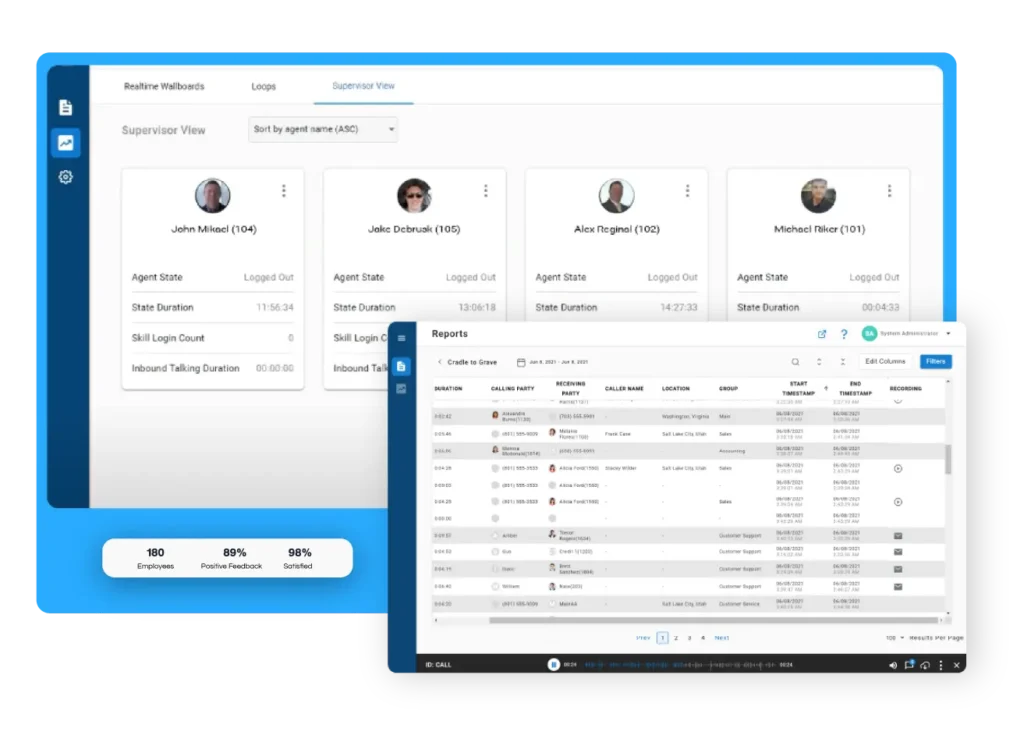
Automated quality assurance, or Auto QA, uses AI, natural language processing, and speech analytics to evaluate customer interactions automatically. Instead of a supervisor listening to a handful of recordings and scoring each one manually, the technology can evaluate every interaction against the same quality and compliance criteria.
That solves a practical problem for small contact centers. Supervisors are often managing queues, answering agent questions, coaching employees, and handling reports alongside QA. Listening to enough calls to get a representative picture of every agent’s performance simply does not fit into the day.
Manual sampling also leaves most customer interactions unseen. Xima notes that traditional QA programs may review only 3% to 5% of interactions, which means an agent’s evaluation can hinge on a very small number of calls while compliance issues and recurring customer problems go unnoticed elsewhere.
Auto QA changes the amount of information a small team can realistically use. Every interaction can be scored without hiring more reviewers, giving supervisors a broader view of quality while freeing up time for the work that still needs a person, especially coaching and agent development.
Key Takeaways
- Automated QA can evaluate 100% of customer interactions, rather than basing quality decisions on the 3% to 5% commonly reviewed through manual sampling.
- AI transcription, natural language processing, and sentiment analysis turn conversations into data that can be evaluated against defined quality criteria.
- Full interaction coverage makes it easier to identify missed disclosures, script deviations, and other potential compliance issues, rather than relying on a random sample.
- Continuous scoring gives supervisors a larger body of evidence for coaching. Feedback can be based on recurring patterns across an agent’s calls rather than on a single unusually good or bad interaction.
- Automating routine scoring gives supervisors more time to work directly with agents instead of spending hours listening to recordings and filling out scorecards.
- Small contact centers should compare Auto QA platforms based on scorecard flexibility, speech analytics, integrations, reporting, and how easily supervisors can turn findings into action.
Why Small Business Call Centers Need Auto QA
Manual quality assurance becomes harder to defend as call volume grows. A supervisor might review several recordings for each agent and still miss nearly everything that happened that week. One employee could be evaluated on an unusually difficult interaction while another agent’s recurring compliance problem never happens to make it into the sample.
For a small business, increasing the sample is not always realistic. There may be no dedicated QA department. The person responsible for reviewing calls may also be responsible for scheduling, reporting, escalations, coaching, and keeping service levels on track. Every hour spent searching for recordings and manually completing evaluations is an hour that cannot be spent working directly with the team.
Moving from a small call sample to 100% interaction coverage changes QA from an educated guess into a view of what is actually happening across the contact center.
Automated contact center quality management gives smaller teams a way to close that gap. When every interaction is evaluated against consistent criteria, supervisors can find repeated service problems, missed process steps, and coaching opportunities that would be difficult to see through occasional reviews.
Coverage also matters for compliance. A required disclosure that is missed on a call does not become less important because that recording was never selected for QA. Automated monitoring can flag interactions that depart from required scripts or procedures, allowing the business to address a problem before it becomes a pattern. Automated QA systems can similarly create a more complete audit trail by evaluating compliance across the interaction set rather than a small statistical sample.
The customer experience benefits from the same visibility. Recurring complaints, unnecessary escalations, poor call handling, and missed revenue opportunities become easier to spot when supervisors can see patterns across hundreds of conversations. Instead of reacting to the loudest complaint or the call that happened to get reviewed, managers have enough information to decide where their attention will make the biggest difference.
How AI-Powered Quality Assurance Works in a Modern Contact Center
The technology behind Auto QA can sound complicated, but the workflow itself is fairly straightforward. A conversation is captured, converted into usable data, evaluated against the organization’s standards, and surfaced to the supervisor.
Here is what that process looks like in practice:
- The interaction is captured and transcribed.
A recorded customer conversation is converted from speech into text. Accurate call transcription matters because everything that follows, from sentiment analysis to compliance detection, depends on correctly understanding what the agent and customer said. Competitor guidance similarly identifies speech-to-text as the foundation on which automated scoring and analysis depend. - AI analyzes the meaning of the conversation.
Natural language processing looks beyond isolated keywords to help identify topics, intent, phrases, and other patterns within the interaction. That makes it possible to distinguish between a word simply appearing in a conversation and the context in which it was actually used. - Sentiment and conversation signals add context.
Word choice and other interaction signals can help identify frustration, satisfaction, or conversations that may deserve closer attention. This gives supervisors another layer of information beyond traditional measures such as handle time. - The interaction is evaluated against defined QA criteria.
Automated scorecards can check whether required steps were followed and measure the behaviors the organization has chosen to evaluate. The same criteria can then be applied consistently instead of changing based on which supervisor happens to review the call. - Results are organized for action.
Rather than handing a supervisor another pile of recordings, Auto QA surfaces scores, exceptions, and trends. Managers can go directly to the calls that need attention and use them for coaching, compliance review, or process improvements.
This is one part of the broader way AI contact centers improve customer service. Xima combines interaction analysis with tools such as Speech Analytics and Auto QA so supervisors can identify patterns across calls instead of relying on a handful of manually reviewed conversations. Xima’s existing AI contact center guidance describes Auto QA as evaluating the full interaction set against defined criteria while surfacing calls that need attention.
Benefits of Automated Quality Assurance in a Call Center
The biggest change with Auto QA is not that scoring happens faster. It is that managers have enough information to make better decisions about individual agents and the operation as a whole.
Targeted Agent Coaching Driven by Data
Coaching based on one or two calls can easily become misleading. An experienced agent may have one unusually difficult conversation. A struggling agent may happen to have a strong call selected for review. Neither tells the supervisor much about normal performance.
Continuous scoring provides a larger body of evidence. Managers can see whether an agent repeatedly struggles with the same process, misses a particular step, or handles certain types of conversations especially well. Coaching can then focus on a demonstrated pattern instead of an isolated moment.
That also makes feedback easier to explain. An agent can see where the issue occurs across their work, while the supervisor has specific interactions available to support the conversation. The result is a fairer and more useful coaching process.
Consistent Regulatory Compliance and Risk Reduction
Compliance monitoring is difficult when most calls are never reviewed. Required disclosures, script adherence, and internal procedures need to be followed whether or not a particular conversation happens to land in a supervisor’s QA sample.
Auto QA can evaluate interactions for defined requirements and flag exceptions for review. Instead of manually searching for potential issues, managers can focus on the calls where a required step may have been missed.
This does not remove the need for human judgment, especially when an issue requires interpretation. It gives that judgment a better starting point. Automated systems can identify exceptions at scale, while supervisors or compliance staff decide what the finding means and what should happen next. Gladia likewise describes the role of automated QA as shifting human reviewers toward exception handling, nuanced decisions, and coaching rather than eliminating them.
Operational Efficiency for QA Managers
Manual QA involves more than listening. Someone has to locate the recording, play the call, enter scores, document findings, and decide whether the interaction warrants follow-up.
Automation removes much of that repetitive work. Supervisors can filter for low-scoring calls, compliance exceptions, negative sentiment, or another criterion that matters to the team and start their review there.
The time saved can go back into leadership. Instead of spending an afternoon trying to find coaching opportunities, the supervisor can spend that afternoon coaching.
Key Features to Look For in Auto QA Software
The best automated QA software for a small call center is not necessarily the platform with the longest feature list. It is the one that makes complete interaction coverage useful without creating another complicated system for supervisors to manage.
Look for capabilities such as:
- Flexible scorecards and evaluation criteria. Your QA program should reflect the way your team actually works. Customizable scorecards and evaluations make it possible to measure the behaviors, procedures, and service standards that matter to your organization rather than forcing every team into the same rubric.
- Strong speech analytics. Auto QA depends on understanding the underlying conversation. Look for speech analytics that can transcribe interactions, identify topics and sentiment, support compliance monitoring, and make conversations easy to search and review.
- Clear reporting and interaction-level detail. A score alone does not tell a supervisor what to do next. Useful reporting should make it easy to move from a broader trend into the calls behind it so managers can understand what is driving the result.
- Integration with your existing environment. Small teams rarely have the appetite for replacing every system just to improve QA. Evaluate how easily the platform works with your phone system and the other tools agents and supervisors already use.
- Coaching workflows tied to QA findings. The purpose of scoring is improvement. A strong platform should make it straightforward to turn a quality finding into specific feedback, training, or follow-up.
- Workforce visibility beyond individual QA scores. Connecting quality findings with workforce management data can give supervisors more context around performance, adherence, scheduling, and service-level demands.
- Consistent compliance monitoring. Look for the ability to evaluate required language and processes across the full interaction set, then surface exceptions for human review.
For smaller contact centers, usability deserves just as much attention as technical capability. If managers need a dedicated analyst to understand what the QA platform is telling them, much of the value of automation is lost.
Transform Small Business Call Management with Xima Automated QA
Xima Auto QA is built for contact centers that need broader quality visibility without building a larger QA department around it. Instead of asking supervisors to manually sample calls, Xima can evaluate 100% of interactions against the criteria the business cares about and surface the conversations that need attention. Xima’s AI platform Auto QA provides full interaction coverage, consistent quality monitoring, and automatically surfaced coaching opportunities.
That changes what a small team can do with the time it already has. Supervisors can see patterns in agent performance, identify coaching needs, and investigate compliance exceptions without spending hours searching through recordings. Speech analytics adds context around topics and sentiment, while automated scoring gives managers a consistent baseline for evaluating performance.
Most importantly, the technology supports the supervisor rather than trying to replace the role. Automation handles the repetitive review work. People still coach, make judgment calls, recognize strong performance, and decide how the team should improve.
If your QA process still depends on a small sample of calls, schedule a personalized Xima demo to see how Auto QA, Speech Analytics, and Xima’s reporting tools can give your team a clearer view of every customer interaction.
FAQs About Automated Call Center Quality Assurance
Implementation time depends on the existing phone environment, integrations, QA criteria, and the scope of the rollout. Smaller teams can often make adoption easier by defining their scorecards and evaluation goals before implementation rather than trying to automate every possible QA process at once.
No. Auto QA is best used to automate repetitive monitoring and scoring while leaving coaching, exception review, and nuanced decisions to people. It allows QA managers and supervisors to spend less time finding problems and more time addressing them.
Speech analytics systems are designed to process real contact center conversations, but audio quality still matters. Background noise, overlapping speakers, accents, and compressed telephony audio can affect transcription accuracy, so organizations should evaluate a platform using recordings that reflect their actual call environment.
Quality assurance focuses on evaluating interactions and determining whether agents are meeting defined service, process, and compliance standards. Quality management is broader and uses those findings to support coaching, training, process improvement, and ongoing performance management.
Pricing varies based on the platform, number of users, interaction volume, included AI capabilities, and integrations. Small businesses should compare total value rather than subscription price alone, including how much manual review time the platform can reduce and whether important capabilities require separate products or add-ons.