A missed callback, a compliance issue buried in a recording, or an agent who keeps running into the same customer problem can be hard to spot when supervisors are working from a small sample of calls.
AI call analysis gives contact centers another way to look at those interactions. Instead of relying only on manual reviews, teams can use AI to transcribe, analyze, score, and organize call data across a much larger share of their conversations. For small and mid-sized contact centers, that means better visibility without building a larger QA team.
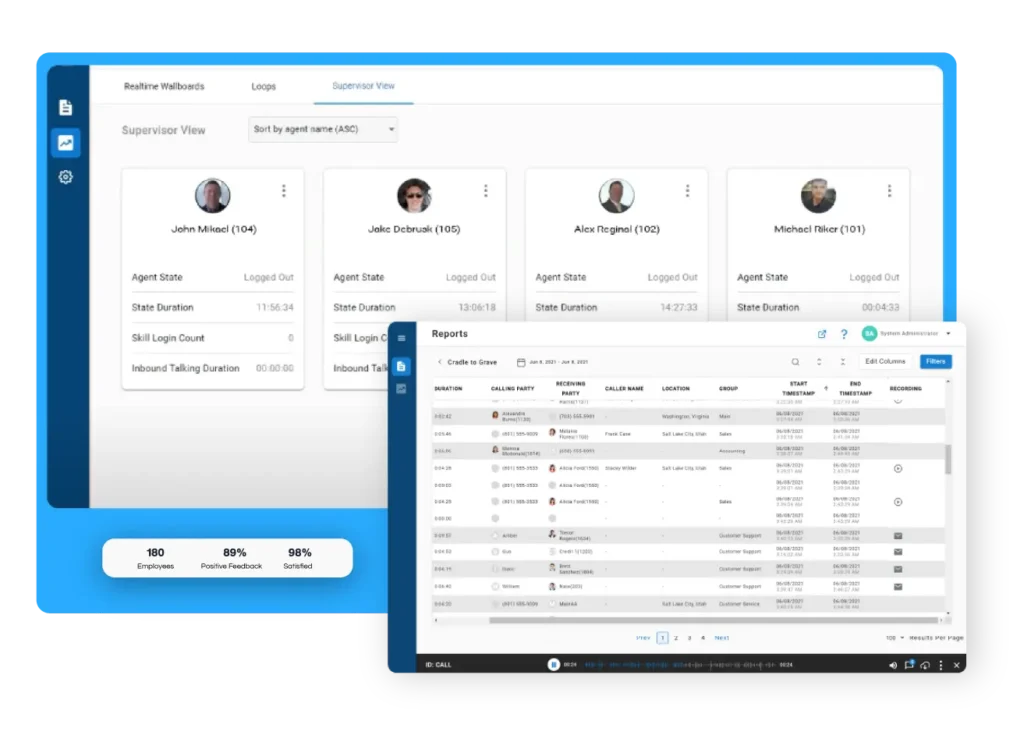
AI call analysis builds on the call recording and reporting tools many teams already have. It can help supervisors identify performance gaps, monitor compliance, understand customer sentiment, and spot recurring issues while there is still time to act on them.
This guide covers how AI call analysis works, where it fits into daily contact center operations, common use cases, and what to look for when evaluating the technology.
What Is AI Call Analysis?
AI call analysis uses artificial intelligence to turn phone conversations into structured information that contact center teams can use. A system can transcribe calls, identify speakers, analyze language and sentiment, and surface patterns related to agent performance, customer needs, compliance, and call outcomes.
The process starts with the conversation itself. Speech-to-text technology creates a written record of what was said, while language analysis helps identify topics, intent, and context. From there, the system can surface information such as sentiment changes, common call reasons, talk and listen patterns, possible churn signals, or areas where an agent may need additional support.
That difference matters. Basic keyword spotting might tell a supervisor that the word “cancel” appeared on a call. Conversation intelligence can provide more context around why the customer mentioned cancellation, how the conversation progressed, and whether the issue was resolved.
For supervisors, the value is practical. The same data can support quality assurance, agent coaching, compliance reviews, customer experience analysis, and broader operational decisions.
How Does AI Call Analysis Work?
AI call analysis follows a series of steps that turn raw audio into information a supervisor can use.
Step 1: Audio Transcription
The process begins with recorded or live call audio. Automated speech recognition converts the conversation into text and can separate the agent’s speech from the customer’s speech so the system can accurately determine who said what.
That transcript becomes the foundation for everything that follows. With reliable call center recording software, teams have a complete source of interaction data that can be searched and analyzed instead of stored and rarely revisited.
Step 2: Sentiment Analysis
Once the conversation has been transcribed, AI can look at the language and other conversational signals to identify changes in customer sentiment. Depending on the system, this can include word choice, phrasing, speech patterns, and changes in the direction of the conversation.
For example, a customer may begin a call calmly and become increasingly frustrated after a transfer or an extended hold. Contact center speech analytics can help surface those shifts so supervisors can investigate what happened.
Sentiment analysis can also be useful after the call. Trends across many interactions can show whether customers are consistently frustrated by a particular process, product, or type of interaction. Teams can use those patterns alongside sentiment analysis in contact centers to identify problems that may not show up in standard KPIs.
Step 3: Call Summarization
Long conversations contain a lot of information that agents would otherwise have to document manually. AI can condense a call into key points, customer requests, outcomes, and follow-up items.
That can reduce repetitive after-call work while giving supervisors a faster way to understand what happened without listening to the entire recording. It also creates a more consistent source of notes for downstream reporting and CRM workflows.
Step 4: Automated Scoring
AI can evaluate a conversation against the quality standards a contact center has defined. Those criteria might include required disclosures, script adherence, communication behaviors, compliance requirements, or specific service standards.
Instead of waiting for a supervisor to select a recording for review, automated scoring can flag interactions that need attention. This gives managers a more consistent view of quality and makes it easier to identify both strong performance and potential problems.
Step 5: Trend and Insight Generation
The real value starts to grow when the system looks beyond individual calls.
By analyzing conversations across the contact center, AI can uncover repeated customer complaints, emerging product issues, frequent competitor mentions, recurring transfer problems, or patterns in agent performance. A supervisor may discover that one issue appearing on a handful of calls is actually showing up across hundreds of interactions.
That broader view gives leadership better information for coaching, process changes, staffing decisions, and customer experience improvements.
How Call Centers Benefit from Analyzing Calls with AI
The goal is not to collect more data for its own sake. AI contact center software becomes useful when it helps a team spend less time searching and more time acting.
- Lower operating costs: Automated evaluation reduces the amount of manual work involved in traditional QA. Teams can review a much larger portion of their call volume without adding the same number of supervisors or evaluators required for manual review.
- Increased agent productivity: Automated summaries and reduced after-call work give agents less administrative work to complete after each interaction. That can help reduce handle time and leave more of an agent’s shift available for customer conversations.
- Automated quality assurance and compliance: AI can evaluate every interaction against defined scorecards, disclosures, and script requirements rather than relying entirely on a small sample. This creates a broader view of quality and helps surface potential compliance issues sooner. Strong contact center compliance practices also give teams a clearer record of what happened when an interaction is reviewed later.
- Targeted agent coaching: Supervisors can move from reviewing random recordings to focusing on calls that reveal a specific coaching need. Objective scoring and selected call excerpts give managers concrete examples to use during one-on-one conversations.
Xima’s broader AI contact center software approach brings these capabilities together with reporting and operational workflows, so the information produced by call analysis has somewhere useful to go.
How to Use AI Call Analysis in Your Daily Operations
AI call analysis works best when it becomes part of the normal management rhythm rather than another dashboard that no one checks.
Step 1: Set Up Custom Evaluation Criteria and Keywords
Start with the issues that matter most to your operation. That could include required compliance language, prohibited phrases, specific customer issues, product names, escalation triggers, or service standards.
Custom criteria make the analysis more useful because supervisors are looking for the signals that actually matter to their business.
Step 2: Review Automated QA Scores and Call Summaries
Instead of manually opening recordings at random, supervisors can begin with automatically scored interactions and summaries. Calls that fall outside expectations can be prioritized for review, while routine interactions can remain available without requiring the same level of manual attention.
This changes the supervisor’s workflow from searching for problems to reviewing the problems that have already been surfaced.
Step 3: Run Targeted 1-on-1 Agent Coaching
The next step is turning the findings into useful conversations with agents. A supervisor might use a call excerpt, sentiment timestamp, or scorecard result to show exactly where an interaction went off track.
The best coaching is specific. Rather than saying an agent needs to “improve communication,” a supervisor can point to repeated patterns across calls and work with the agent on a particular behavior.
This approach aligns closely with how AI speech analytics can give small business supervisors better coaching visibility without adding hours of manual review.
Step 4: Track Contact Center Trends and Pain Points
Individual calls matter, but recurring patterns often tell the bigger story.
Supervisors can use aggregated reporting to identify repeated complaints, emerging product issues, training gaps, or queues that consistently produce longer or more difficult interactions. Over time, these trends can help teams decide whether they need to change a process, update training, improve self-service, or adjust staffing.
Common Use Cases of AI Call Analysis
AI call analysis can support several parts of contact center management at once. The most useful applications tend to connect directly to a metric, risk area, or operational decision.
- Quality assurance: AI can evaluate a much broader set of conversations for script adherence, communication quality, empathy, required disclosures, and other QA criteria. That gives supervisors more information to work with than a limited manual sample.
- Compliance monitoring: Continuous analysis can flag potentially missed disclosures, prohibited language, or deviations from approved processes. For regulated teams, broader coverage can make compliance monitoring more consistent and easier to audit.
- Customer experience improvement: Call reasons, frustration patterns, and repeat issues can reveal where customers are struggling. Teams can use that information to improve processes, refine self-service options, or address issues that are driving repeat contacts.
- Agent coaching: Supervisors can identify recurring behaviors across multiple interactions rather than basing feedback on one isolated call. High-performing interactions can also become examples of effective techniques that other agents can learn from.
- Operational efficiency: Automating transcription, review, scoring, and summaries reduces the amount of time managers spend working through recordings and documentation. That time can instead go toward targeted interventions and team leadership.
- Sales and renewals: For phone-based sales teams, AI can surface patterns around objections, buying intent, call drop-off, or successful talk tracks. Those insights can help teams understand where customers lose interest and which conversations are more likely to move forward.
Turning AI Call Insights into Better Decisions with Xima
AI call analysis is most useful when the insights make it into the workflows managers already rely on.
With Xima, conversation data can support real-time dashboards, alerts, reports, and coaching workflows instead of sitting in a separate analytics system. Supervisors can look at trends and outliers, identify where performance is changing, and then decide what needs attention.
A spike in handle time might lead to a review of the conversations driving it. A pattern of negative sentiment might point to a product issue or a process that needs to change. Repeated compliance misses might signal a coaching opportunity or a script that needs to be revisited.
That connection between conversation data and contact center KPIs is what makes AI call analytics actionable. Leaders can see not only that a metric changed, but also the customer and agent interactions behind the change.
Xima brings together speech analytics, automated QA, reporting, and real-time visibility so supervisors can spend less time digging through data and more time improving the operation.
Ready to see how it works in practice? Request a demo of Xima Software and see how AI-powered call analysis can fit into your existing contact center workflows.
FAQs About AI Call Analysis
Accuracy depends on factors such as audio quality, accents, background noise, overlapping speech, and the technology being used. Strong speech analytics systems combine transcription with language analysis and other signals so teams can get useful context rather than relying on exact word matches alone.
AI can identify topics, customer intent, sentiment, compliance issues, agent behaviors, common complaints, and recurring patterns across interactions. Teams can use those insights for QA, coaching, customer experience analysis, and operational planning.
Security depends on the platform and how interaction data is handled. Contact centers should evaluate encryption, access controls, retention policies, compliance requirements, and the way recordings and transcripts are stored and accessed.
Both are possible. Real-time analysis can surface sentiment and other signals while an interaction is happening, while post-call analysis can support scoring, summaries, trend analysis, and coaching after the conversation ends.