
Every contact center manager knows the feeling. An auditor requests interaction records. A regulator asks for documentation. A supervisor needs to pull a specific call from three months ago.
And suddenly, what should be a straightforward task turns into a scramble across siloed systems, incomplete logs, and recordings that may or may not be where you left them.
Call center compliance doesn’t have to work this way. The problem, more often than not, isn’t the regulation. It’s the tooling.
Why Call Center Compliance Gets Complicated
Most contact centers weren’t built with compliance as a first principle. They were built for call handling, then patched for compliance over time: a recording tool here, an access control setting there, a third-party audit log bolted on at the end.
The result is a patchwork. And patchworks have gaps.
When compliance infrastructure is fragmented, three things tend to happen. First, coverage becomes inconsistent. A call gets recorded, but a chat doesn’t. A voice interaction gets logged, but an SMS exchange isn’t captured anywhere in an auditable way. Second, retrieval becomes slow. Responding to a regulatory request takes hours of manual work instead of minutes. Third, oversight becomes reactive. Supervisors find out about a compliance issue after the fact, not in time to intervene.
None of these are inevitable. They’re symptoms of software that treats compliance as an afterthought.
What Compliance-Ready Actually Looks Like
A contact center platform that’s built for compliance does a few specific things well.
It captures everything. Not a sample, not the calls a supervisor remembered to flag: every interaction, across every channel. Voice, chat, email, and SMS. When an auditor asks for a complete interaction history, the answer is a search query, not a week of manual reconstruction.
It protects sensitive data automatically. In healthcare, that means pausing recordings when a patient shares protected health information. In financial services, it means stopping capture during card number entry to ensure PCI DSS requirements are met, without asking agents to remember a manual step mid-call. The protection happens in the background, consistently, regardless of which agent is on the call.
It controls who sees what. Role-based access means agents access only what’s relevant to their work. Supervisors see their teams. Administrators manage the system. Nobody has more access than they need, which is exactly what regulators want to see.
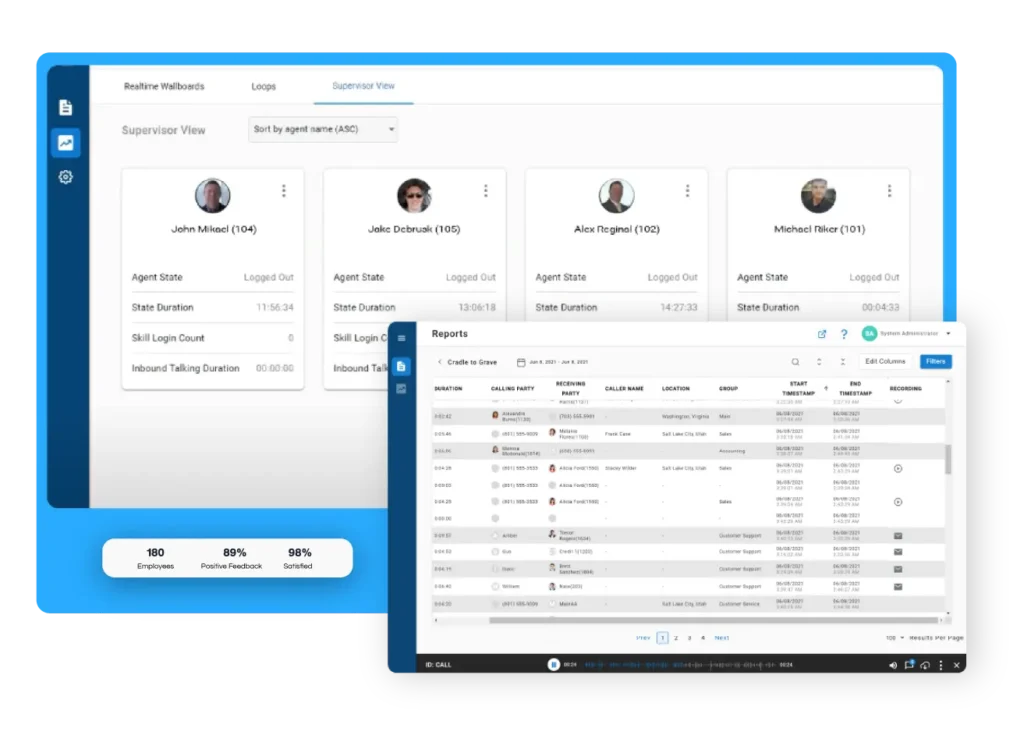
It gives supervisors real-time visibility. Call center compliance isn’t only about record-keeping after the fact. It’s about catching problems as they happen. Live monitoring and sentiment alerts let supervisors intervene in a call that’s going wrong before a frustrated customer files a formal complaint or a procedural slip becomes a documented violation.
The Specific Regulations Contact Centers Are Managing
HIPAA governs patient data in healthcare contact centers. The requirements that matter most in practice are secure call recording, PHI pause functionality, and audit-ready interaction logs that can be produced on request.
PCI DSS governs payment card data. If your agents take card payments over the phone, sensitive data pause is non-negotiable. Recordings that capture card numbers are liabilities, not assets.
GDPR and CCPA govern how customer personal data is collected, stored, and used. Contact centers handling customers in Europe or California need clear data handling practices, documented consent where required, and the ability to respond to subject access requests.
SOC 2 is less a legal requirement than a trust signal, but increasingly a procurement requirement. If you’re selling to enterprise customers or operating in regulated industries, SOC 2 certification demonstrates that your platform meets independent security and availability standards.
Managing all of this across disconnected tools is where call center compliance overhead comes from. Managing it inside a single platform is where it goes away.
How Xima Approaches Call Center Compliance
Xima’s compliance tools aren’t a separate module or an enterprise add-on. They’re built into the platform, which means they’re active by default, consistent across every interaction, and visible in the same interface your supervisors are already using.
Secure call recording with sensitive data pause protects PHI and payment card data without requiring changes to agent behavior. Role-based access controls limit exposure at the user level. Cradle-to-grave interaction logs give you a complete, searchable record of every conversation across every channel. And because it’s all inside a single platform, there’s no integration gap where data goes missing and no vendor handoff when an auditor comes calling.
For mid-market and SMB contact centers, this is the part that matters most: Xima brings enterprise-grade call center compliance infrastructure to organizations without a dedicated compliance team or the budget for multiple specialist tools.

The Practical Upside
Compliance done right isn’t just about avoiding fines. It’s about removing the overhead that compliance currently costs you in manual work, reactive firefighting, and the low-level anxiety of not being certain your records are complete.
When your platform handles the heavy lifting, your supervisors spend less time on audit prep and more time on coaching. Your agents don’t have to remember compliance steps mid-call. And when a regulator or auditor does come knocking, you’re ready in minutes.
That’s what simplified call center compliance looks like. It’s not about making regulations easier. It’s about making your software equal to them.